Making room for people to belong.
Every community has its rituals of welcome. Often the first question we ask when meeting someone new is ‘where are you from?’ The response allows a story to begin between us, we step in a little closer, find a common ground. The answer to that question could be the name of a town, or a city, or a state, or a country, depending on the context. As people, we are also from an emotional place: a family, a culture, a faith, a community, a war zone, a displacement, a great love we have followed or a heartbreak we have left behind.
“Where are you from?” looks backwards. To arrive in a new place, or even return to a place you knew once before, begs a different question: how do you belong here now? Recent Tasmanian Leaders research describes belonging as one of the defining leadership challenges of our time. In a State where communities are close-knit yet loneliness remains among the highest in Australia. Belonging can not be left to chance. It requires leaders willing to create environments through action where people feel psychologically safe, welcomed and connected to both place and purpose in a way that is integrated, rather than assimilated.
Sometimes that leadership is undertaken in ways that signal a formal belonging – citizenship ceremonies, visa approvals, job sponsorships. Perhaps the more potent actions are the tiny ones that signal trust and connection – an invitation to dinner and a seat at the table. Someone remembering your name the second time they meet you, connecting you to their network so you are stitched a little more into the community. It is these moments that often determine how a place begins to feel like home.
When a Learning Set from TLP8 in 2014 set out to create a Tasmanian version of the Welcome Dinner Project more than a decade ago as their Community Action Project, their ambition extended well beyond sharing a meal. The concept was simple. Small groups of established Tasmanians and newly arrived migrants, refugees, asylum seekers and international students would gather in homes across the state, each bringing a dish to share. Conversation and curiosity would replace assumption and uncertainty. The dinners were designed to be local, making it easier for relationships to continue after the evening ended, supported by trained facilitators and community partners committed to creating welcoming spaces.
At one level, the project addressed a practical challenge. New migrants often experience profound social isolation after settling in Australia, while many long-term residents simply don’t know how to make those first connections. The Welcome Dinners created a bridge between two groups living alongside one another but rarely together. Viewed through the lens of leadership, a dinner was the emergent beginning of a conversation that might continue through friendships, neighbourhoods, workplaces and community organisations.
Twenty years later, our experience shows that Community Action Projects rarely finish when the year long program concludes. They become invitations for others to continue the work. The Welcome Dinner initiative sought partnerships with migrant organisations, local councils, community houses, the University of Tasmania and local service clubs, deliberately designing a model that could grow beyond the original Learning Set and become part of Tasmania’s social fabric.
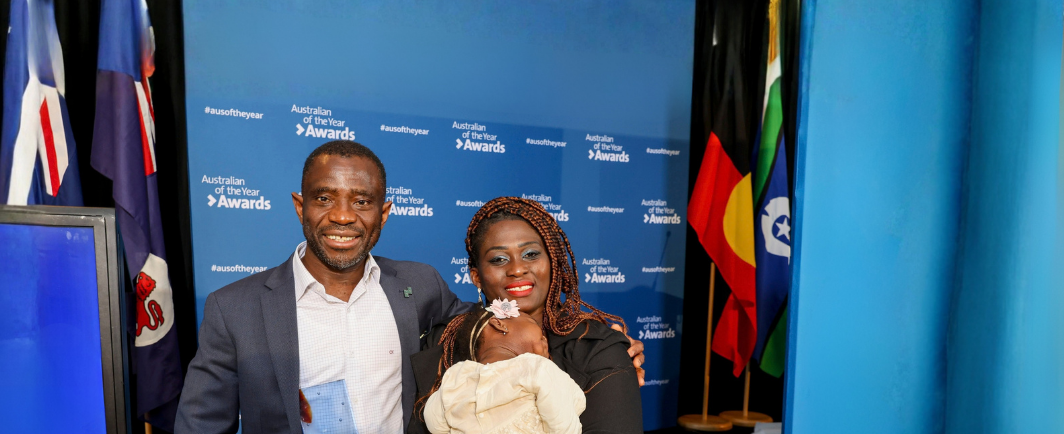
Over the last two decades, not only have Community Action Projects created the conditions for belonging, the Tasmanian Leaders flagship program has been a community for new and returning Tasmanians to discover and connect with other humans. John Kamara TLP16 came from war ravaged Sierra Leone to Tasmania and found a voice for his advocacy, winning the Tasmanian Australian of the Year award in 2024. After completing the program in 2009, Amanda Castray TLP3 went from Tasmania to Northern Ireland to continue to grow her executive leadership in tertiary education before returning with her family to UTAS as Pro Vice Chancellor – Campus Life.
Suzie Han TLP18 stepped off a plane from her home town in China with scant English skills and an ambition to succeed, completing a Masters of Education, Suzie is currently Head of Senior School at St Michael’s Collegiate. Dr Miranda Hann came from America and undertook her medical studies in Australia. A TLP17 graduate, she is an award winning leader in the general practice provision of LGBTIQA+ healthcare in Southern Tasmania. The Tasmanian Leaders graduate community is rich with stories like these, reflecting belonging and connection as a core pillar of the program design.
While across the globe we are as humans and nations increasingly characterised by loneliness, polarisation and uncertainty, belonging creates the firm ground underneath us that can make the uncertain feel more certain.
Leadership begins not from there, but from here – by making sure there is always a seat at the table, ready to belong.